Phase-2 Pilot Authorized — Kolaghat, Purba Medinipur · Feb 26, 2026

FROM
ORBIT
TO ACTION

Satellite Aided Thermal Anomaly Response Kit

SATARK detects crop fire anomalies from space, upscales them 200× with AI, and dispatches a Guardian to the exact field — in under 30 minutes. We don't police farmers. We give them a way out.

30min
Orbit to Intervention
200×
AI Upscaling
10K+
Families Protected
30+
Student Guardians
6
Global Advisors
Scroll

Not a
surveillance
tool.

Stubble burning bleeds India $24 billion annually. The official response is broken — satellites record, police fine, but there are zero logistics to actually stop the fires.

"The matchstick costs ₹1. It is the only technology within her budget. SATARK is not about catching her; it is about giving her a second option."— Field Validation Report, 2026

Our field survey across 34 farming households found 0 of 34 knew government-subsidised machinery (CHCs) existed — despite 36 centres operating in their district. The solution isn't absent. The logistics bridge is.

S
Satellite
INSAT-3DR · GK-2A · every 15 min
A
Aided
SwinIR transformer · cascaded ×200
T
Thermal
Heat mapped to exact crop boundaries
A
Anomaly
LULC-filtered · zero false positives
R
Response
WhatsApp dispatch · Guardian network
K
Kit
Open-source · free · built for India
The Logic Loop — Orbit to Action in ~30 min
01
Satellite DetectionINSAT-3DR & GK-2A feeds every 15 minutes — 2× faster than NASA VIIRS daily passes.
Intelligence
02
SwinIR AI UpscalingBlurry 4km pixels reconstructed via cascaded Swin Transformer to precise 20m coordinates. ~120ms inference.
SATARK PRIME
03
LULC Precision FilterCross-checked on Land Use Land Cover maps. Factory or road → discard. Agricultural land → alert.
Zero False Positives
04
Guardian DispatchWhatsApp API with GPS + village name + live Maps link. No login. One tap to act.
Dispatch
05
Situational ActionHappy Seeder, wind-guided Smart Burn, or immediate extinguish — dictated by atmospheric reality.
Response

We see the fire
before it starts.

SATARK's intelligence pipeline starts weeks before any flame. NDVI tracking detects the Green-to-Brown crop shift — alerting administration to dispatch balers days before the farmer feels forced to burn.

Step 1 · 14 Days Before
NDVI Green-to-Brown Detection
We track Normalized Difference Vegetation Index via Sentinel-2. When a field shifts from active crop green to post-harvest brown, SATARK flags it as a high-risk burn candidate — days before the matchstick is considered.
Step 2 · AI Engine
Cascaded SwinIR — The Mitra Bridge
Instead of a single 4km→20m jump (which causes AI hallucination — as warned by Dr. B.K. Mohan, IIT Bombay), we built a 3-step ladder: MODIS stabilises at 1km, Landsat-8 teaches heat at 100m, Sentinel-2 pins fire to farm boundaries at 20m. x200 total upscaling. 120ms inference.
Step 3 · IoT Ground Truth
SATARK SENTRY Mk I — School Nodes
Solar ESP32 nodes deployed at village schools track micro-wind corridors and temperature inversions in real time. If smoke drifts away from the village, a controlled Smart Burn is approved. If the atmosphere is stagnant (inversion mode), immediate extinguish is ordered. 50-node pilot authorized by BDO Feb 2026.
Step 4 · Domain Adaptation
Trained on California, Built for Bengal
Indian farm fires vanish too fast for deep learning datasets. We mined 32,000+ images from California's 2020 August Complex Fire to teach the AI the physics of heat — then domain-adapted using Bengal LULC data per Dr. Adway Mitra (IIT Kharagpur) to recognise Bengal's unique spectral fire signature.
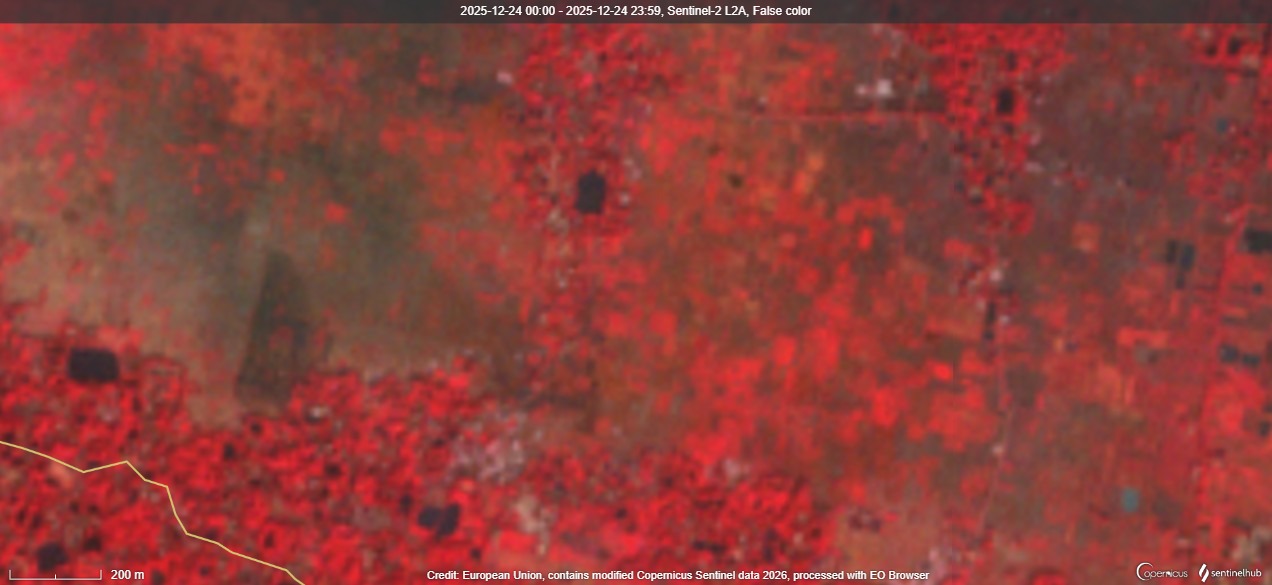
Sentinel-2 False Color — Purba Medinipur Dec 24 2025
Live Satellite Data · Sentinel-2 L2A False Color
Dec 24, 2025 · Purba Medinipur. Dark patches = harvested/burnt fields. Smoke plume visible upper-left. Active crop = deep red. This is the data SATARK's NDVI pipeline processes. Credit: EU / Copernicus Sentinel 2026.
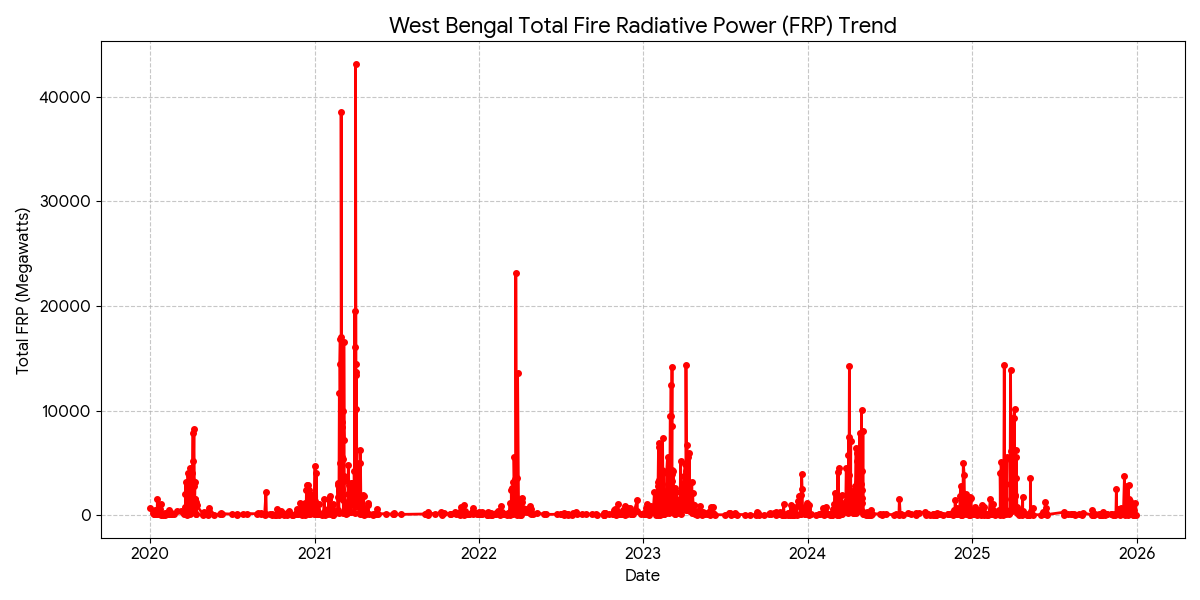
West Bengal Fire Radiative Power Trend 2020-2026
VIIRS Data · West Bengal FRP 2020–2026
Total Fire Radiative Power (Megawatts). March–April and November harvest windows drive recurring spikes. SATARK's deployment is targeted at these exact windows — when logistics intervention prevents the most burns.
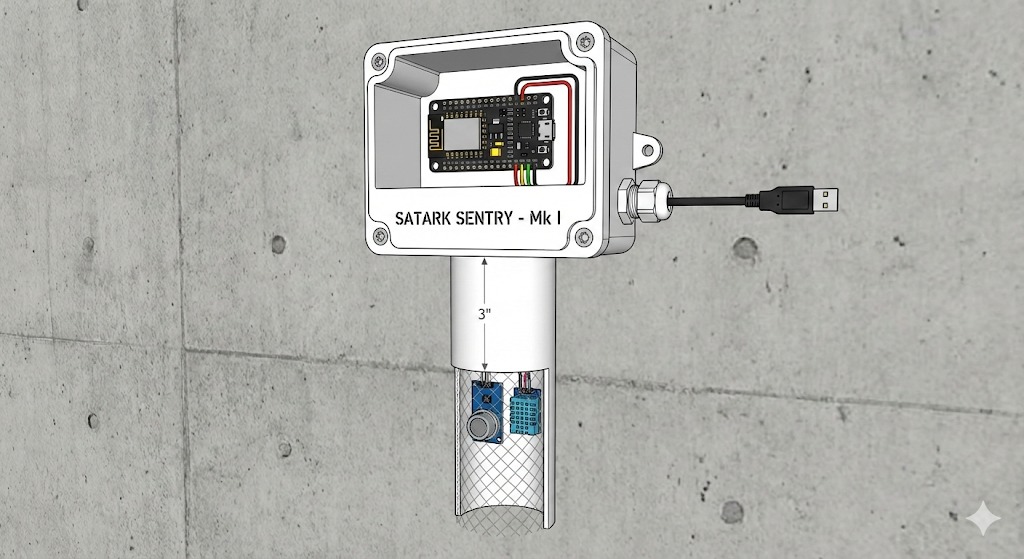
SATARK SENTRY Mk I IoT node
Hardware · SATARK SENTRY Mk I
Solar ESP32 node with MQ gas sensor and DHT humidity probe. Deployed at village schools as micro-climate observatories. Enables hyper-local Smart Burn decisions — what commercial weather apps can't see at farm scale.
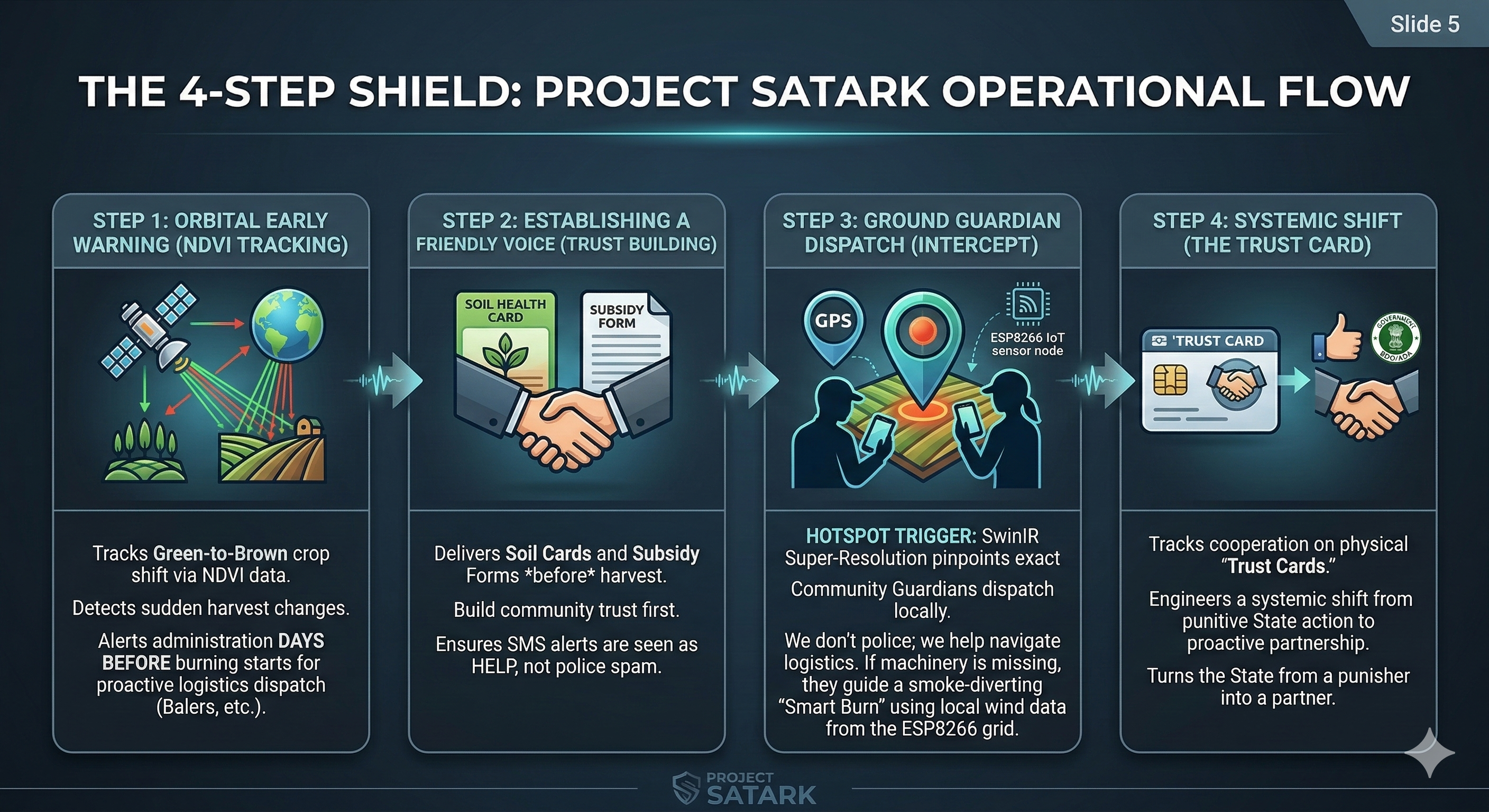
The 4-Step Shield.

SATARK doesn't just watch the fire — we stop the match. A complete prevention-to-response system that manages the crisis before it burns.

The 4-Step Shield: SATARK Operational Flow
01
Orbital Early Warning
NDVI tracks the Green-to-Brown crop shift. Alerts admin to dispatch balers days before the farmer feels forced to burn. Prevention before the harvest window opens.
02
Friendly Voice First
Soil Health Cards and Subsidy Forms delivered before harvest season. Trust built first. Ensures SATARK alerts are received as help, not surveillance. The 11th Gift protocol in action.
03
Ground Guardian Dispatch
SwinIR pins the exact farm. Guardian dispatched. If machinery is missing, they guide a Smart Burn using SENTRY IoT wind data — smoke diverted away from villages.
04
The Trust Card
Physical cards track cooperation. Engineers a systemic shift — State becomes partner, not punisher. Trust Cards earn priority access to government machinery and subsidies.

An invisible
gas chamber.

The Himalayas and Vindhyas trap the Indo-Gangetic Plain. Smoke flows east into a blind alley. West Bengal is the sink — and VIIRS data shows a 200% rise in local fires. We are now producing our own.

$24B
Annual economic bleed
Lost soil microbiome, crop damage, fertilizer addiction, health costs — every year
5.3
Years of life stolen
From every child in the Indo-Gangetic Plain by toxic air alone
140MT
Carbon bomb — annually
More CO₂ in two harvest weeks than Sweden emits in a full year

"The smoke chokes the breath out of me. We know it is poison. But if we do not burn, we do not plant. And if we do not plant, we do not eat."

— Majidan Bibi, Farmer · Kolaghat Block, Purba Medinipur · Field Validation Report 2026
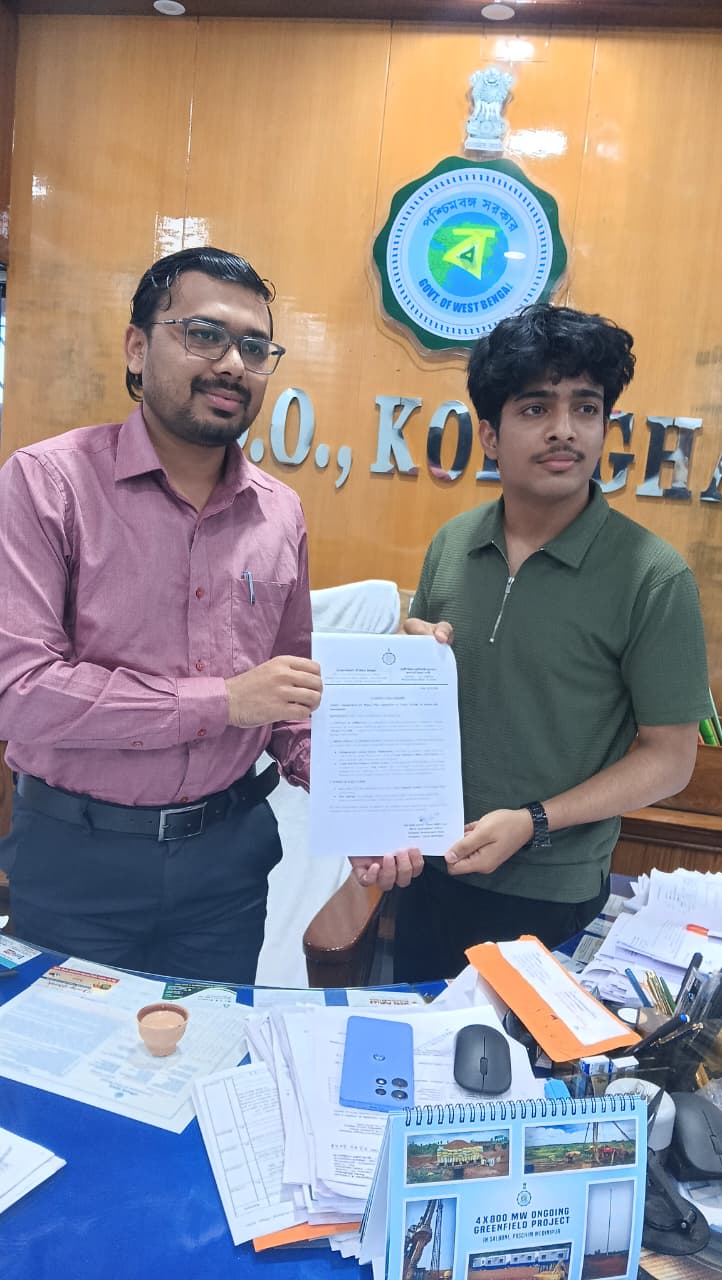
Sk Reezaal Arafat receiving Phase-2 authorization from BDO Kolaghat
Official Authorization — Phase-2 Pilot · Feb 26, 2026
Sk Reezaal Arafat with BDO Shri Amit Kumar Chand · Kolaghat Development Block, Purba Medinipur

From
fine to
forecast.

On February 26, 2026, the BDO of Kolaghat officially authorized Phase-2 deployment. This is the same network the state uses to fine farmers — now repurposed to protect them. A pivot of personnel, not money.

50-node IoT pilot grid authorized across Kolaghat Block — LoRaWAN SENTRY sensors on Gram Panchayat offices and flood shelters.
School access granted — Atal Tinkering Labs authorized for device assembly and Student Technical Team formation.
Zero financial liability to the block. Real-time dashboard access continuously provided to Block Office.
All Gram Panchayat Pradhans formally requested to provide logistical cooperation to the deployment team.

If a matchstick costs ₹1,
the solution must be free.

Three phases. One goal: institutionalize SATARK as government policy. We aim to recover the 5.3 years of life expectancy stolen from 500 million people by toxic air.

1
Active Now
The Build
Phase 1 · Current
AI training on 32,000+ California wildfire images adapted for Bengal. Trust audit complete (n=34 farms). First indigenous Bengal fire dataset locked. BDO + ADA authorization secured. SENTRY Mk I prototyped.
2
Authorized
The Pilot
Phase 2 · March 2026
4-state deployment during Rabi harvest. 50-node SENTRY IoT grid live across Kolaghat Block. Guardian Network on ground. Live predictions vs government machinery deployment — proving the Efficiency Gap.
3
Target
Full Scale
Phase 3 · Winter 2026
Full Indo-Gangetic Plain. ISRO Bhuvan integration. Trust Cards as formal government subsidy metric. Architecture open-sourced for Mekong Delta — Thailand and Vietnam. 1 million families protected.

Built by the
people it serves.

Join the Mission →
Sk Reezaal Arafat
Project Director & Founder
Sk Reezaal Arafat
Student from Kolaghat — the same district SATARK serves. Designed the full system: satellite pipeline, SwinIR architecture, Trust Card protocol, Guardian network, and government authorization pathway. Earth Prize Applicant.
VR
Lead Operations · Mumbai
Vidyanand Rathod
Operations Advisor. Strategic oversight and cross-zone coordination.
SP
Lead Ops · Sahid Matangini
Soumyadip Paryali
Field operations lead for Sahid Matangini Block. Farmer engagement and trust-building.
MA
Lead Operations · Panskura
Md Sami Alam
Field operations lead for Panskura zone. Community liaison and deployment.
SD
Field Guardian Manager · Siddha
Sagar Das
Supervises all Field Guardians. Deploys, debriefs, and validates all ground reports.
DK
Director of Narrative & Guardian Interaction Management · Jharkhand
Diya Kumari
Leads storytelling, community communication, and Guardian interaction frameworks across Jharkhand operations.
SJ
Area Operations Coordinator
Sujoy Patra
Panskura 1 cluster. Bridges Lead Ops and ground Guardians.
AR
Institutional Attaché
Arif Rahman
Embedded in schools and ATL labs. Manages student technical teams and institutional onboarding.
SA
Field Guardian
Soumyadeep Adhikari
Primary ground unit. Farmer engagement, data collection, and Trust Card protocol.
SK
Field Guardian
Sanket Kuila
Field data collection and farmer liaison in active burn zones.
Guardian Network
Sabarna Samanta Rehan Mallick Srijan Pal Arka Hazra + 30 active guardians and growing →

Peer-reviewed
before deployment.

Every feature — from SwinIR architecture to the 11th Gift social logic — was engineered in direct response to this council's constraints. SATARK is advised by 11 global experts spanning remote sensing, AI, behavioral economics, ecology, and venture — including Tyler Cowen (George Mason / Emergent Ventures), Shruti Rajagopalan (Emergent Ventures India), Kailash Nadh (CTO, Zerodha), Michael Gibson (1517 Fund), Soren Monroe-Anderson (Neros), and Prof. Pallavi Singh. Core technical advisors below.

Northeastern University · Harvard
Dr. Daniel Aldrich
Professor & Director of Resilience Studies
Trust isn't built during the crisis; it's spent during the crisis. The intervention must come from a trusted local source, not a surveillance apparatus.
CSRE, IIT Bombay
Dr. B.K. Mohan
Professor, Centre of Studies in Resources Engineering
Do not chase impossible resolution. Super-resolving 4km to 200m is the absolute physical limit. Beyond that, data becomes noise.
IIT Kharagpur
Dr. Adway Mitra
Professor of Computer Science & Artificial Intelligence
Domain adaptation is a must. Pre-train on US LULC data to learn terrain features before attempting thermal detection in Bengal.
Columbia University
Dr. Ruth DeFries
Co-Founding Dean & Professor of Ecology and Sustainable Development
Farmers are not villains; they are economic actors. There must be an economic incentive and a logistics bridge to make collection possible.
Zerodha · FOSS Tech Leader
Kailash Nadh
CTO, Zerodha
Open-source architecture and lean engineering — building public-good technology that scales without corporate capture.
Neros
Soren Monroe-Anderson
Co-Founder & CEO, Neros
Early-stage climate ventures succeed when they build trust infrastructure before product infrastructure — community first, technology second.

From the
ground.

All Reports →

Stop being
a victim of
the smoke.

30+ student Guardians decided to stop watching and start fixing. We need builders, field operators, data scientists, and communicators. If you breathe this air, this is your fight too.

AI / ML Engineer IoT / Hardware Field Guardian Data Analyst Communication Policy Research
Apply to Join → Contact the Team